


This is subsequent analysis of business opportunities for Polish companies, which takes into account macroeconomic as well geopolitical factors and changes in the global economy.
The study includes:
- ranking of investment destinations,
- analysis of key market trends,
- results of survey conducted among entrepreneurs,
- analysis of the Ukrainian market, including impact of the war and the planned reconstruction process,
- review of foreign investment financing instruments offered by development institutions.
This year's edition of the ranking includes two categories of destinations - obvious and known (1st circle) and less known, but very promising for FDIs (2nd circle). The demarcation line is the value of capital invested by Polish companies (EUR 100 million). In the first group - mainly geographically and culturally closer CEE countries, top spots are held by Czechia, Romania and Ukraine, where potentially great opportunities may open up for Polish enterprises as part of the country's reconstruction process. Within the second circle countries, Japan, Kazakhstan and Malaysia are on the podium.
"There is a chance for our business to be finally more active abroad. So far, although we have been successful in attracting investments from other countries, our regional neighbours have been better at outbound capital expansion. We want to share knowledge about the benefits and opportunities of international development and show Polish entrepreneurs specific markets worth considering when looking for investment opportunities. At KUKE, we see a growing interest among Polish businesses in going international. To reinforce this trend, we offer attractive instruments to secure the investments themselves as well as their financing, which significantly increases the security of foreign investment."
Janusz Władyczak, CEO of KUKE
Download the report:

Ranking of the most promising directions for Polish foreign investments
Although currently most Polish direct investments are located in Europe (over 84% in terms of cumulative value in 2020), and companies most often indicate nearby European destinations as potential new investment locations, there are many other, less obvious directions with a significant unexplored potential.
The report "Polish foreign investments: new trends and directions" presents the most interesting of them, taking into account the impact of the Covid-19 pandemic on the attractiveness of individual countries. The ranking favors countries that have coped relatively best with the effects of the pandemic in terms of the inflow of foreign direct investment. It was also decided to try to map the impact of current geopolitical events on short-term investor sentiment.
In the basic ranking of the most promising destinations for Polish foreign investments, the highest places were taken by: India, Finland, Estonia, Israel and Chile. These are rapidly growing markets, taking many initiatives to increase their business attractiveness to foreign investors.
“When choosing the direction and specific goal of a foreign investment, it should be remembered that they must fit into the company's long-term development strategy. These cannot be decisions detached from the company’s business model”.
Piotr Kuba, Member of the Management Board responsible for Investments at PFR TFI
Cooperation and support in the implementation of foreign investments
In addition to the ranking, the report also presents the results of research carried out on a sample of 240 medium and large Polish enterprises. They clearly show how important the first experiences on foreign markets are for the next steps in the international development of companies.
“Companies that have already learned about the specifics of doing business abroad can see the benefits and profits it can bring. Among the surveyed companies investing abroad, almost 60 percent announced willingness for further expansion”.
Paweł Oleszczuk, Vice Director at PwC Polska
The situation is the opposite in the group of enterprises that do not invest abroad - the vast majority of 80 percent has no specific plans in this regard. This shows that it is worth encouraging companies to expand abroad and showing them the benefits associated with it. Solutions offered by institutions such as the Foreign Expansion Fund managed by PFR TFI or KUKE, may be helpful here. Working with them can facilitate and accelerate international business development.
Global trends on the foreign direct investment market
The authors of the report present the key trends on the foreign direct investment (FDI) market and point to their importance for Polish companies. These trends could have been observed before, but the Covid-19 pandemic turned out to be their accelerator. The most important phenomena include: securing supply chains, screening foreign direct investment and increasing protectionism, the e-commerce revolution, reducing the carbon footprint and implementing ESG practices, as well as new technologies and the use of artificial intelligence.
“The Covid-19 pandemic, the e-commerce revolution, the need to secure supply chains are factors that make the approach to FDI change dynamically. One of the responses to these phenomena is the regionalization of investments and the formation of state blocs. You can also see that more and more countries are introducing procedures that hamper foreign investment”.
Janusz Władyczak, President and CEO of KUKE
Dowload the report i Polish
Geographic distribution of Polish exports to the Middle East
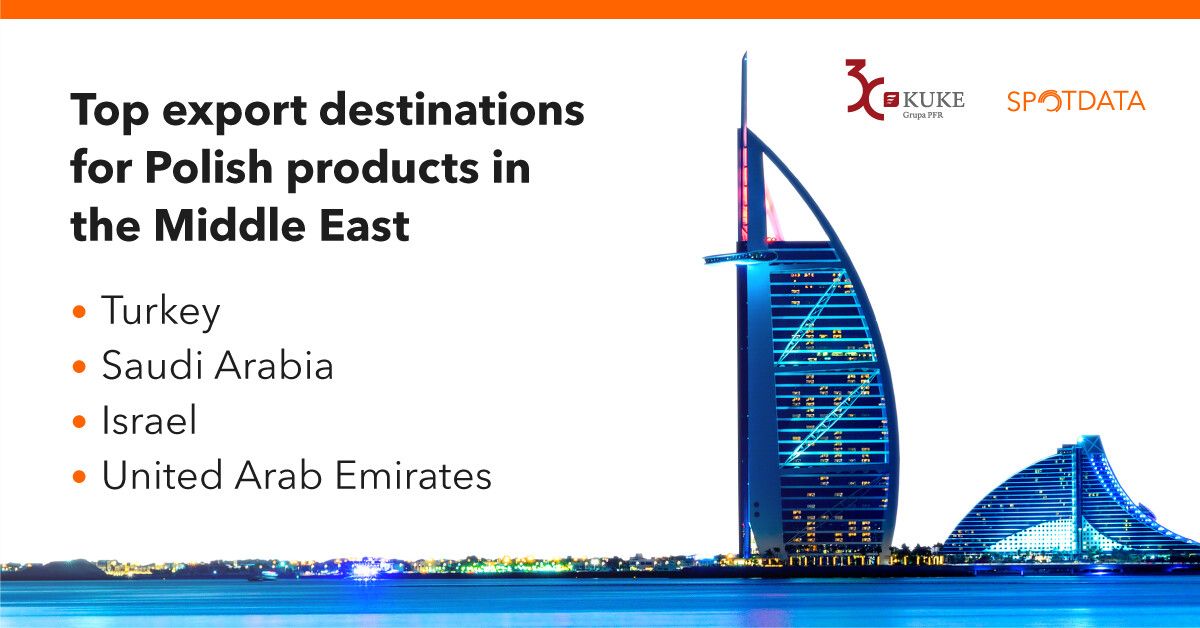
The main countries in the Middle East to which exports from Poland go to are Turkey, Saudi Arabia, Israel, and the United Arab Emirates. In the years 2001–2020, the total value of exported goods to all the countries in the Middle East has increased from around USD 0.5 to 5.1 billion, and their share in Polish exports has risen from 1.2% to 2.2%. This means, for instance, that the share of countries in the Middle East in total Polish exports of goods is generally smaller than that of Hungary (2.5%) and half the size of the Netherlands (4.2%). This is nevertheless a potentially promising market considering, for example, the number of inhabitants (e.g., Turkey 82 million persons, Iran 82 million persons, and Saudi Arabia 34 million persons). In this group of countries, Turkey has the largest share in Polish exports (0.9%, USD 2.2 million in 2020), followed by Saudi Arabia (0.4%, approx. USD 1 billion in 2020) and Israel (0.3%, approx. USD 0.7 billion in 2020).
Top Polish products exported to the Middle East
In 2020, wheat had the largest share in exports of goods to the Middle East (approx. USD 360 million), which was sold by Polish companies almost exclusively to Saudi Arabia. Although wheat had a significant, increasing share in the exports of goods to countries in the region over the past decade, it constituted Poland’s export hit only in 2020. A year earlier, in 2019, railway wagons (approx. USD 250 million) had the largest share in exports from Poland to Middle Eastern countries, most of which were sold by Polish enterprises exclusively to the United Arab Emirates as part of the investments in the development of their track-based modes of transport. There was a similar situation in 2018 when railway wagons were in fourth position on the list of the highest in value export commodities. Back then, their main buyer was Saudi Arabia which was also modernizing its rail system.
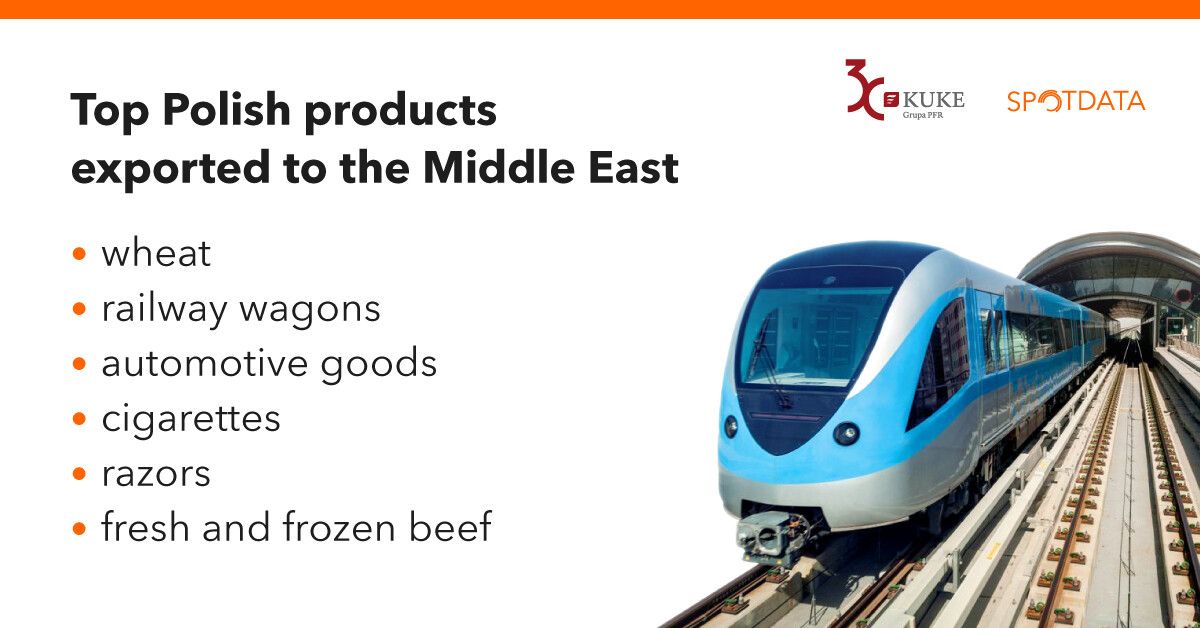
Apart from wheat and railway wagons, which in recent years climbed to the top of the Polish export hit list to the Middle East, sales of Polish companies to countries in the region are dominated by products of the automotive industry, mainly combustion engines (approx. USD 200 million in 2020), passenger cars (approx. USD 180 million in 2020), and vehicle parts and accessories (approx. USD 120 million in 2020). Although almost continuous growth was recorded since 2017 for combustion engine sales – at the time reaching a value of approx. USD 350 million – their sales slowed greatly in subsequent years (down to a level of approx. USD 200 million in 2020). Similarly, after 2017, there was a significant reduction in the volume of sales of passenger cars from approx. USD 444 million in 2017 to USD 180 million in 2020. This gap was only partially compensated by the increased sales of car parts, which was up from approx. USD 50 million in 2014 to USD 120 million in 2020.
In 2020, cigarettes also constituted one of top Polish products sold to buyers in the Middle East. Sales of cigarettes grew from approx. USD 10 million to over USD 150 million – almost exclusively due to rise in exports to Saudi Arabia.
Another export hit to countries in this region are razors – their sales from Poland have been growing systematically since 2011, reaching USD 160 million in 2020.
Fresh and frozen beef also holds a high position in Polish exports to the countries of the Middle East. This is a top Polish export product sold to Israel, which annually imports beef from Poland worth approx. USD 80 million. In 2018, Turkey was the largest importer of beef in the region (approx. USD 110 million), but Polish manufacturers could not maintain their presence on this market in the following years.